
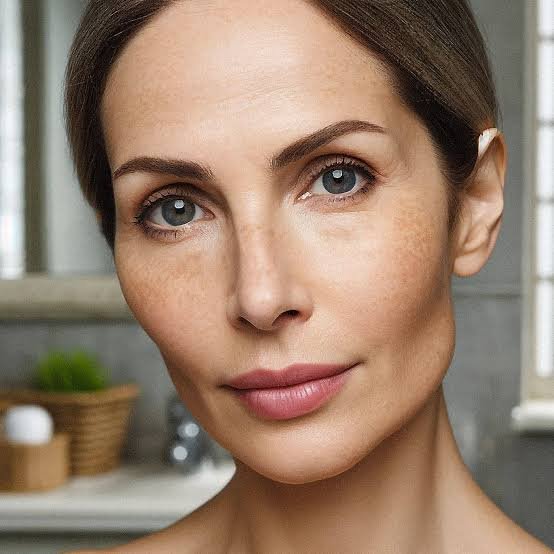
Skin at 45 is not just older, it is biologically different. Estrogen withdrawal in perimenopause changes how skin makes collagen, ceramides, and hyaluronic acid, which changes which ingredients actually move the needle.
The aisle markets dozens of “anti-aging” actives, yet only a handful have randomized controlled trial evidence in mature or estrogen-depleted skin. That gap between marketing volume and clinical signal is where most women lose money and patience.
The best skincare ingredients for women over 45 are the few that match the biology. This explainer covers the hormonal mechanism, the actives with the strongest published evidence, how to manage retinol tolerance once skin becomes reactive, and the layering order dermatologists recommend.
Why Skin Changes After 45: The Hormone Mechanism
Estrogen regulates three of the skin’s most important structural systems, and all three falter when its levels fall. Research by Brincat and colleagues, cited by the American Academy of Dermatology, shows women lose roughly 30% of skin collagen in the first five years after menopause, then around 2% each year after. Dermal thinning of about 1.13% per year compounds the change.
Ceramides decline through a specific enzymatic pathway. Estrogen regulates serine palmitoyltransferase (SPT), the rate-limiting enzyme for ceramide production. When estrogen drops, SPT activity drops, so skin builds fewer and shorter ceramides. A 2022 lipidomic study in Scientific Reports confirmed post-menopausal skin had significantly lower CER[NDS], CER[NS], and CER[NP] (p<0.001) with shorter carbon chains (p<0.0001). Women on hormone replacement therapy showed ceramide profiles matching pre-menopausal skin.
Hyaluronic acid follows the same pattern. Estrogen up-regulates hyaluronan synthase and the CD44 receptor, so falling estrogen reduces endogenous HA and the skin’s ability to hold water.
Perimenopause is more volatile than postmenopause because estrogen swings erratically rather than settling low. As Dr. Renita Ahluwalia notes, “Perimenopause is the ideal time to be proactive.”
The Ingredients With the Strongest Clinical Evidence
Five actives have the most robust trial data for this life stage. Each addresses a specific deficit created by the hormonal shifts above.
Retinol. A 2007 JAMA Dermatology trial by Kafi and colleagues applied 0.4% retinol to one arm of 36 participants (mean age 87) over 24 weeks. Fine wrinkles improved significantly versus vehicle (P<.001), glycosaminoglycan expression rose 40% (P=.02), and procollagen I synthesis increased significantly (P=.049). The dual mechanism (GAG induction for hydration plus procollagen for matrix remodeling) is why Dr. Ahluwalia calls retinoids “the single best topical for structural anti-aging changes.”
Ceramides. Because menopausal skin produces fewer and shorter ceramides through the SPT pathway, topical ceramides replace what skin can no longer synthesize at the same rate. They reinforce the barrier, reduce transepidermal water loss, and calm reactivity.
Niacinamide (Vitamin B3). A 12-week double-blind RCT by Bissett and colleagues (International Journal of Cosmetic Science, 2004) studied 50 women using 5% niacinamide. Results showed significant improvement in fine lines, wrinkles, hyperpigmented spots, red blotchiness, sallowness, and elasticity. The anti-inflammatory profile suits perimenopausal skin, which trends toward redness.
Vitamin C (L-ascorbic acid). A split-face trial of 50 women aged 40 to 59 using 20% L-ascorbic acid found significant improvement in color, elasticity, radiance, smoothness, and wrinkles at two months. Vitamin C is a cofactor for the lysyl and prolyl hydroxylase enzymes that build collagen, and it inhibits MMP-1, which degrades it. Use in the morning with a stable formulation.
Hyaluronic acid. Topical HA addresses the estrogen-driven decline in endogenous synthesis. Apply to slightly damp skin so it draws moisture inward. On dry skin, HA can pull water from the deeper dermis outward and leave skin feeling tighter.
No topical reverses 30% collagen loss. These actives slow further loss, repair barrier function, and visibly soften lines.
Managing Retinol Tolerance After 45 (and What to Use If You Cannot)
Retinol is the strongest topical for structural change, but estrogen-depleted skin is more reactive, so the application protocol matters as much as the molecule.
Start low and slow. Dr. Justine Kluk, a consultant dermatologist, advises that “retinol 0.3 is a good starting strength for most.” For more sensitive perimenopausal skin, begin at 0.025% on two or three non-consecutive nights and build to nightly over six to twelve weeks.
The “sandwich method” reduces irritation during build-up: moisturizer, then retinol, then moisturizer. The buffer slows absorption without eliminating efficacy.
Do not pair vitamin C and retinol in the same step. Dr. Shereene Idriss warns that “layering too many actives disrupts the acid mantle and accelerates sensitivity in women over 45.” Use vitamin C in the morning and retinol at night.
For skin that cannot tolerate retinol, bakuchiol is the only plant-derived alternative with head-to-head RCT data. A 2019 British Journal of Dermatology trial by Dhaliwal and colleagues compared 0.5% bakuchiol twice daily with 0.5% retinol once daily over 12 weeks in 44 patients. The groups showed no significant difference in wrinkle surface area or hyperpigmentation reduction, but the retinol group reported significantly more scaling and stinging. Bakuchiol is non-inferior with better tolerability, not a stronger active.
Sunscreen: Still the Most Important Product on the Shelf
Daily broad-spectrum sunscreen is the most evidence-supported anti-aging intervention available. The Hughes et al. Australian sunscreen trial demonstrated reduced photoaging over 4.5 years among daily users versus discretionary users.
Hormonal context strengthens the case. UV radiation is the primary driver of matrix metalloproteinase activation, which breaks down dermal collagen. When estrogen-driven collagen synthesis is already falling at roughly 2% per year post-menopause, UV-driven breakdown compounds that loss in a way no serum can offset. SPF is structural protection, not a cosmetic finishing step.
Use SPF 30 or higher, broad-spectrum, every morning regardless of weather or season. The American Academy of Dermatology lists daily sun protection as the first habit for healthier skin after 50.
Putting It Into a Routine: Layering Order and the Simplicity Principle
Layering order follows one rule: thinnest and water-based first, occlusive and SPF last.
Morning: cleanse, hyaluronic acid on damp skin, vitamin C, ceramide moisturizer, broad-spectrum SPF.
Evening: cleanse, niacinamide (if used), retinol or bakuchiol, ceramide moisturizer, and on dry-skin nights an optional facial oil such as rosehip or sea buckthorn as a final seal.
Four to six well-chosen products outperform a 12-step routine in mature skin because reactivity itself accelerates visible aging. Dr. Idriss puts it plainly: “Layering too many actives disrupts the acid mantle and accelerates sensitivity in women over 45.”
Avoid three pairings: vitamin C and retinol in the same application, stacked exfoliating acids, and starting two new actives at once. Each raises barrier-disruption risk without adding benefit.
For a step-by-step daily walkthrough calibrated to mature skin, this skincare routine for mature women guide expands on each step.
Frequently Asked Questions At what age should women start using retinol?
Dermatologists recommend introducing retinol at 0.025% to 0.3% during perimenopause, typically the mid-to-late 40s, when estrogen-driven collagen loss accelerates. Dr. Ahluwalia calls perimenopause “the ideal time to be proactive.” Earlier introduction at lower strengths improves long-term tolerance. It is never too late to start: the JAMA Dermatology study showed efficacy at a mean participant age of 87.
Are natural ingredients as effective as retinol for wrinkles?
Most are not, but bakuchiol is the exception. The 2019 British Journal of Dermatology RCT found 0.5% bakuchiol produced wrinkle and pigmentation reduction statistically equivalent to 0.5% retinol over 12 weeks, with significantly less stinging and scaling. No other plant-based ingredient has comparable head-to-head clinical data against retinol.
Can topical skincare replace estrogen’s effect on skin?
No. Topicals cannot fully restore the structural collagen and ceramide synthesis that estrogen drives. Targeted actives (retinoids, ceramides, niacinamide, daily SPF) measurably slow further loss and repair barrier function. The 2022 Scientific Reports lipidomic study found only systemic hormone replacement therapy restored ceramide levels to the pre-menopausal range.