Medically Reviewed
This article has been reviewed for clinical accuracy.
If you have ever sat in the dental chair and watched your clinician load a small, gritty paste into a spinning rubber cup before working it across your teeth, you have witnessed prophylaxis paste in action. For many patients, it is simply the bit of the appointment that leaves a minty taste and a smooth, clean feeling. For the dental team, it is a carefully chosen professional material with specific clinical purposes, multiple formulation options, and clear boundaries around who is permitted to apply it.
This article explains what prophylaxis paste is, what it contains, how clinicians choose and use it, what separates it from the toothpaste patients reach for every morning, and the important role that dental nurses play in making the procedure run smoothly and safely, even though direct application falls outside their scope of practice as defined by the General Dental Council (GDC).
What Is Prophylaxis Paste?
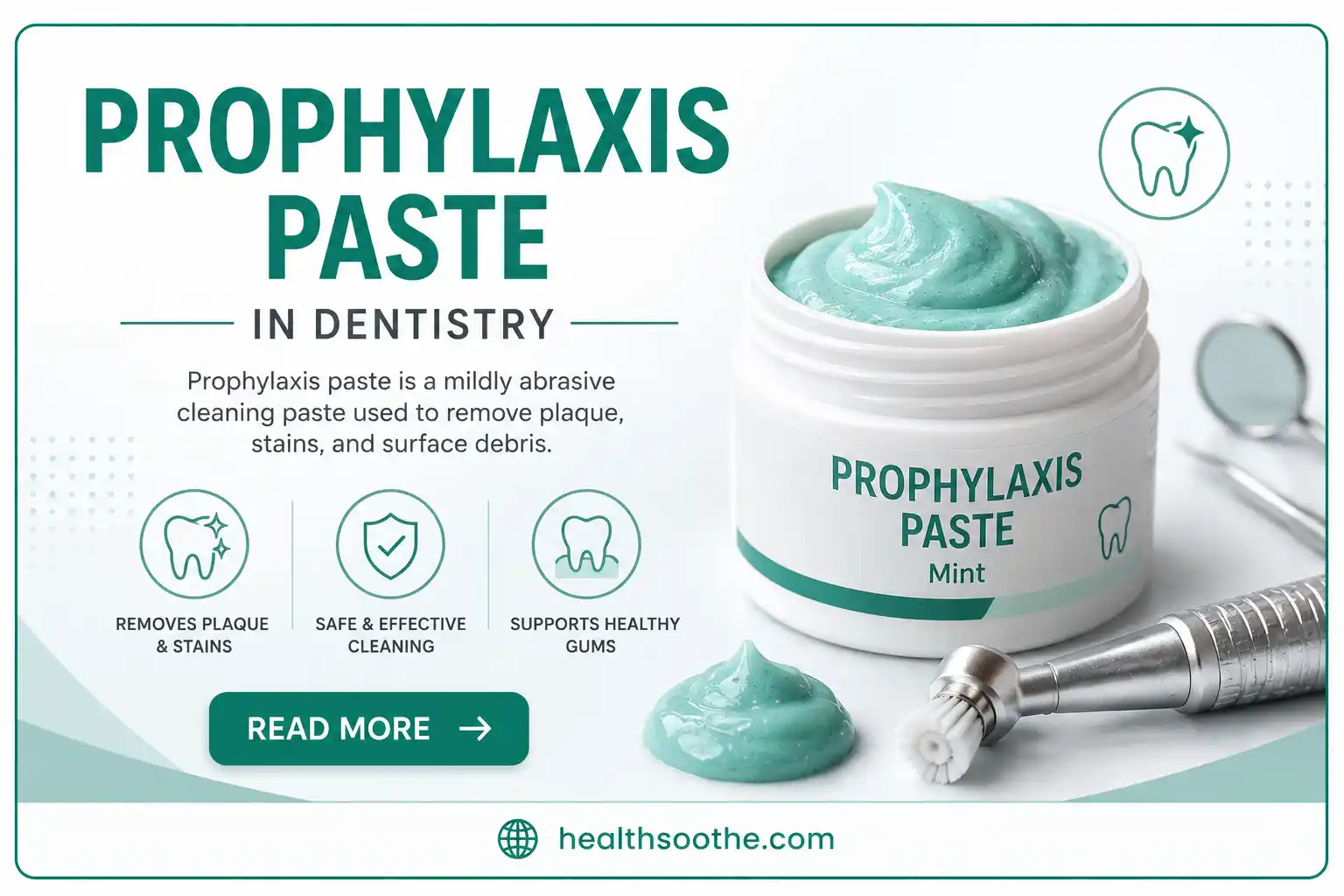
Prophylaxis paste, routinely shortened to prophy paste, takes its name from the Greek word prophylaxis, meaning to guard against or prevent. As Kent Express describes it, prophy paste is a dental paste containing mild abrasives used for polishing teeth and removing plaque, calculus, and staining, as well as helping to prevent future dental caries. It is a preventive material, not a restorative one, and it sits firmly within professional clinical use rather than home care.
Dental-Nursing.co.uk sets out the broader context: dental prophylaxis typically consists of placing pumice or an abrasive paste in a rubber cup and applying the paste to the clinical crowns of the teeth using a rotating rubber cup at slow speed. The aim is the complete removal of plaque, salivary pellicle, materia alba, and extrinsic stains found on the crowns of teeth. When this is achieved consistently and correctly, it reduces the conditions in which future dental caries can develop.
A prophylaxis is indicated for patients with healthy gingiva as a preventative measure, and it is commonly performed after a routine hygiene appointment such as a scale and polish. A clinician may also elect to perform a prophylaxis before taking an impression or before in-house tooth whitening to ensure the best possible result is achieved from either procedure (Dental-Nursing.co.uk, 2022; Robinson and Bird, 2012).
What Is Prophy Paste Made Of?
Understanding what goes into prophy paste explains both its effectiveness and why it is not suitable for daily home use. According to Kent Express, prophy pastes contain a mixture of binders, humectants, colouring agents, preservatives, fluoride, flavourings, and an abrasive material. The abrasive is the defining ingredient. Either chalk (calcium carbonate) or pumice, which is a volcanic rock, is used as the abrasive in most dental prophy pastes.
Quora dental professionals confirm that the key distinction from consumer toothpaste is the pumice powder content. Pumice is a volcanic rock and is highly abrasive. If it were used twice daily by a patient it would cause massive abrasion of the tooth enamel. This is precisely why prophy paste is reserved for controlled, periodic, professionally administered treatment rather than daily brushing.
Many modern formulations also include fluoride compounds such as sodium fluoride or sodium monofluorophosphate. Patent literature cited in research from the United States Patent and Trademark Office shows that fluoride-containing prophy pastes are designed to assist remineralisation of dental enamel during the polishing procedure itself, providing a therapeutic benefit that goes beyond simple stain removal. Preservatives, sweeteners such as sodium saccharin, and flavouring agents complete the formulation.
Thixotropic properties and non-splatter formulas
One practical quality that dental professionals look for is thixotropy. A thixotropic prophy paste stays firm in the rubber cup during loading but flows and becomes more workable under the motion of the handpiece. Kent Express highlights this as a key property to look for because a non-splatter formula minimises mess, keeps the material on the tooth surface where it is needed, and reduces the amount of paste reaching the patient’s throat, which can cause discomfort or gagging.
The Different Grit Grades and How They Are Used
Prophy pastes are categorised primarily by their abrasive grade. Three main grades are in clinical use, and choosing the correct one for each patient requires clinical assessment.
Coarse
This is the most abrasive grade, used for the removal of heavy plaque accumulation and excessive or stubborn staining. The American Academy for Oral and Systemic Health (AAOSH) notes that coarse grit agents can create deep scratches and roughen tooth surfaces, making the surface more likely to harbour plaque biofilm and staining after the appointment. For this reason, coarse paste should only be used where clinically indicated and should not be used routinely on all patients.
Medium
Medium grit strikes a balance between cleaning effectiveness and surface preservation. Kent Express describes it as suitable for the removal of plaque in most patients and appropriate for routine appointments. Many practices use medium grit as their standard choice for healthy adult patients without significant staining or enamel concerns.
Fine
Fine grit is the least abrasive option. It is used for polishing and the removal of light plaque, and it produces the smoothest finish. Fine paste or a mixture of fine and medium paste is often preferred for children, for patients with exposed root surfaces, and for those with composite restorations, crowns, or veneers where scratching is a concern. Surgimac.com notes that coarse or even medium-grit pastes can scratch and dull the surface of composite restorations, crowns, and veneers, compromising their appearance and potentially making them more susceptible to future staining.
The abrasivity numbers behind the grades
The Relative Dentin Abrasivity (RDA) scale is the standard measure used to quantify how abrasive a dental product is. The Pankey Institute reports that the RDA of prophy paste can range from 150 for fine grades to over 300 for coarse grades. To put this into context, ideally patients should brush at home with a toothpaste that has an RDA below 80, and the FDA allows consumer toothpastes to be sold with an RDA up to a maximum of 200. Prophy paste regularly exceeds this upper limit, which is why trained clinicians choose the lowest appropriate grade for each patient and why the AAOSH advises that practitioners should use the lowest handpiece speed needed to remove extrinsic stain, in order to reduce the abrasion rate and preserve tooth and material structure.
Research published in the AAOSH resource on evidence-based polishing also notes that professional polishing agents may be 20 times more abrasive to dentine and ten times more abrasive to enamel than the polishing agents found in commercial toothpaste. This figure underscores the importance of clinical judgement in grit selection.
How Prophy Paste Differs From Consumer Toothpaste
This distinction matters both clinically and in terms of patient education, and dental nurses are often the team members patients ask about it.
Consumer toothpaste is formulated for safe, daily use. Its abrasive particles are mild and designed to gently clean away plaque and food debris without wearing down enamel over two minutes of brushing, twice a day, every day. Most consumer toothpastes also contain therapeutic agents, primarily fluoride, intended to provide ongoing protection between dental visits. Surgimac.com describes over-the-counter toothpaste as formulated for this specific purpose and notes that it is not equipped to remove the type of staining or accumulated deposits that prophy paste addresses.
Prophy paste is a professional-grade tool designed for a specific job, namely to remove stubborn extrinsic stains and polish teeth to a high gloss. It contains more abrasive agents than regular toothpaste. It is applied not with a soft-bristled brush but with a rubber cup or prophy brush rotating at controlled speed on a dental handpiece. The Dental Care Center explains that the polish is gritty to help smooth the rough surfaces of teeth where bacteria can adhere, in the same way that sandpaper smooths wood. It removes stains that regular toothbrushing cannot address.
The frequency difference also matters. Studies have shown that the abrasion level of prophy paste is not a significant risk to enamel if it is used twice a year during a dental visit (The Dental Care Center). That calculation breaks down entirely if a patient were to attempt to use prophy paste at home for daily brushing, which is why dental professionals do not recommend home use under any circumstances.
What the Dentist and Hygienist Actually Do
The application of prophylaxis paste is the responsibility of the dentist or dental hygienist. Under the GDC Scope of Practice guidance, which was revised and updated in November 2025 following a review and public consultation, the only dental professionals with prophylaxis within their scope of practice are dentists and hygienists. Dental therapists may also carry out polishing where they have been trained and are competent. Dental-Nursing.co.uk is explicit that administering prophylaxis paste directly is not within a dental nurse’s scope of practice.
The clinical procedure
The clinician begins by assessing the patient’s teeth to determine which grit grade is appropriate. This involves looking at the level of staining, the presence of any restorations, the condition of the gingiva, and whether the patient has any sensitivity. A patient with exposed root surfaces, for example, needs a low-abrasive or non-abrasive paste to avoid worsening sensitivity.
The selected paste is loaded into the rubber cup or prophy brush attached to the prophy angle, which is a disposable handpiece attachment. The handpiece is then run at slow speed, and the clinician works the paste across each tooth surface in a controlled, systematic manner. Kent Express confirms that this cleaning takes place supragivally, meaning above the gum line. Any cleaning needed below the gum line is addressed by a separate scaling procedure and is not the function of prophy paste.
After the procedure, the teeth are rinsed thoroughly to remove all paste residue. If a fluoride treatment follows, the paste has already prepared the clean tooth surface to allow fluoride to penetrate effectively. Wonderful Dental notes that prophy paste prepares the teeth for fluoride treatments by ensuring the surface is clean and smooth, which is one reason clinicians sometimes schedule polishing before fluoride application rather than after scaling alone.
Grit selection in clinical practice
A common real-world approach used in practices, as reflected in discussions on professional forums including Reddit’s r/DentalAssistant, is to start with a medium-grade paste for most routine patients and switch to fine for finishing, or for specific areas such as around restorations or on patients with sensitivity. There is no universal rule because the right choice depends entirely on the individual patient. Some clinicians combine grades within a single appointment, using coarse on heavily stained posterior teeth and finishing with fine on anterior teeth where cosmetic results are more visible.
When prophy paste may not be indicated
Not every patient who attends for a check-up or hygiene appointment automatically receives a prophylaxis. Clinicians exercise selective polishing, which means they polish only where there is a clinical reason to do so. A patient with no extrinsic staining, minimal plaque, and healthy enamel may not benefit significantly from routine prophylaxis, and a clinician who applies coarse paste to such a patient without reason is doing more harm than good. AAOSH guidance reflects the current evidence that selective polishing based on individual patient need is the preferred approach over blanket routine polishing.
The Dental Nurse’s Role in Prophylaxis Paste Procedures
Although the dental nurse does not apply prophy paste directly, their contribution to the procedure is far from peripheral. It is, in fact, foundational to how the procedure runs, how the patient experiences it, and whether it meets the standard of care the practice intends to deliver.
Preparing the clinical area
Dental-Nursing.co.uk emphasises that the dental nurse is in a prime position to ensure that the preparation for the procedure is flawless, by having the required material and handpiece already prepared before the patient comes into the room. This level of efficiency helps to portray a high level of professionalism, which the patient interprets as a feeling of calm within the clinical environment.
In practical terms, preparation includes ensuring that the correct prophy angle is assembled, that the selected grit grade is available in the cup holder or unit, that suction tips are in place, that the patient’s bib and protective eyewear are ready, and that the work surface is clean and decontaminated according to infection prevention and control protocols. The GDC’s updated Scope of Practice guidance (November 2025) lists maintaining high standards of infection prevention and control and preparing the clinical area and equipment for treatment as core dental nursing tasks.
Patient support and anxiety management
Dental-Nursing.co.uk notes that a patient will often look to the dental nurse for reassurance if they are experiencing anxiety, either with regard to dental treatment or if they have not experienced a particular treatment before. This is especially relevant for patients attending their first prophylaxis appointment, or for children who are unfamiliar with the sensation of the rubber cup and the gritty paste.
The GDC Skills England Apprenticeship Standard for dental nurses (2023) includes specific skill descriptors around managing patient anxiety appropriately, effectively, and safely, and monitoring, supporting and reassuring patients through effective communication and behavioural techniques. These skills are not passive. They require the nurse to read the patient, offer timely reassurance, maintain eye contact, explain each step in accessible language, and respond to visible signs of distress.
Assisting with suction and moisture control
During the polishing procedure itself, the dental nurse manages the aspirator to keep the oral environment clear of paste, water, and saliva. This supports the clinician’s ability to see the tooth surfaces clearly, protects the patient’s airway from aspirating prophy paste, and keeps the patient comfortable. Effective suction technique during prophylaxis requires the nurse to anticipate where paste accumulates and to work in tandem with the clinician’s movements without obstructing access.
Infection prevention and cross-contamination control
Prophy angles are single-use disposable items in most UK practices, and it is the dental nurse’s responsibility to ensure that used prophy angles are discarded immediately after use and that the handpiece onto which they attach is decontaminated correctly before the next patient. The GDC Scope of Practice (November 2025) is clear that dental nurses are responsible for maintaining high standards of infection prevention and control. In the context of prophy paste procedures, this also includes ensuring that multi-dose tubs of paste are not contaminated through double-dipping with used cups, a known infection control risk if protocols are not followed.
Patient education after the procedure
Once the clinician has completed the prophylaxis, the dental nurse may be in a position to reinforce the messages delivered around home care. This is particularly true in practices where dental nurses work in a dual role that includes oral health education responsibilities. The GDC Scope of Practice allows trained dental nurses to expand into oral health education and promotion, and this is a natural extension of the prophylaxis appointment.
Key messages to reinforce include the importance of twice-daily brushing with a fluoride toothpaste, interdental cleaning, the appropriate toothpaste for the individual patient’s needs, and the reason why prophy paste is not available or suitable for home use. Many patients, after feeling the smooth result of a professional polish, ask whether they can buy prophy paste at home. The dental nurse is well placed to explain the difference clearly and to redirect the patient toward appropriate over-the-counter products.
Record keeping support
The GDC Skills England framework for dental nurses specifies that nurses must accurately record dental charting as carried out by appropriate registrants. In a prophylaxis context, this means the dental nurse may be asked to assist with contemporaneous recording of which teeth received polishing, what grit grade was used, whether any areas were excluded and why, and whether a fluoride treatment followed. Accurate records are essential for continuity of care and for legal and regulatory compliance.
Choosing the Right Prophy Paste for the Practice
When it comes to stocking and selecting prophy paste, the dental nurse may also play a role in product management, stock control, and sometimes in feeding back clinical observations about product performance to the practice manager or clinician. Kent Express offers a useful framework for evaluating which prophy paste to purchase, and many of the same considerations apply to clinical use.
The key factors to consider include:
- Non-splatter performance: A thixotropic paste that stays in the cup reduces mess and improves efficiency during appointments.
- Taste and flavour: Kent Express highlights that patients respond better to pastes with acceptable flavours, and a wide range of options, including mint, citrus, and bubblegum for children, helps accommodate different patient groups.
- Ease of rinsing: A paste that rinses off quickly and completely reduces chair time and keeps the patient comfortable.
- Gluten and allergen status: Kent Express notes that an increasing number of patients follow a gluten-free diet, and choosing a gluten-free paste reduces the risk of reactions and demonstrates patient-centred care.
- Compatibility with restorations: The paste must be safe to use on composites, veneers, and natural enamel alike, which means practices may need more than one grit grade available at all times.
- Fluoride content: Some practices prefer fluoride-containing paste for its remineralising benefit, while others opt for fluoride-free to maintain flexibility in treatment sequencing.
- Cost and value: Prophy paste is one of the most consistently used materials in a practice, so finding a quality product at a sustainable price matters.
Air Polishing as an Alternative
It is worth noting that prophy paste is not the only material available for professional polishing. Kent Express mentions air polishing powder as an alternative material used to achieve similar outcomes. Air polishing units use a stream of pressurised water and fine abrasive powder to remove biofilm and staining, and they can be particularly effective for patients with orthodontic appliances, implants, or complex restorations where a rubber cup is difficult to manoeuvre.
Some practices now use air polishing for supragingival and subgingival biofilm management, and specific low-abrasive powders have been developed for subgingival use. The dental nurse’s role in air polishing procedures mirrors their role in prophy paste procedures in terms of preparation, patient support, suction management, and post-procedure care.
Summary
Prophylaxis paste is a clinically purposeful material with a specific role in preventive dentistry. It is more abrasive than anything available over the counter, it requires trained professional application, and its grit grade must be matched to the individual patient’s clinical need. Dentists and hygienists hold the responsibility for applying it, but the dental nurse’s contribution to the appointment surrounds and supports every aspect of the procedure, from pre-session preparation to post-session patient education.
Understanding the science behind prophy paste, knowing who can administer it, and appreciating what the dental nurse contributes to the process is not simply academic knowledge. It directly shapes the quality of care delivered at every routine hygiene appointment, and it reflects the professional standards that the GDC, through its revised Scope of Practice guidance effective from November 2025, expects of every member of the registered dental team.
Sources and References
- Dental-Nursing.co.uk. An Overview of Prophylaxis Paste and Its Use in Dentistry. dental-nursing.co.uk. Published November 29, 2022.
- Kent Express. How to Find the Best Prophy Paste. kentexpress.co.uk.
- General Dental Council. Guidance on Scope of Practice Effective from 1 November 2025. gdc-uk.org. Published September 16, 2025.
- General Dental Council. Scope of Practice Guidance (Revised). gdc-uk.org. Updated November 2025.
- Skills England / Institute for Apprenticeships. Dental Nurse Occupational Standard (ST1431 v1.0). skillsengland.education.gov.uk. 2023.
- American Academy for Oral and Systemic Health (AAOSH). An Evidence-Based Approach to Cleansing and Polishing Teeth. aaosh.org. August 2024.
- The Pankey Institute / Lee Ann Brady, DMD. Toothpaste and Prophy Paste Abrasion. pankeygram.org; leeannbrady.com.
- Surgimac. Prophy Paste 101: A Complete Guide for Dental Pros. surgimac.com. November 2025.
- Wonderful Dental. Prophy Paste vs Toothpaste: Understanding the Differences. wonderfuldental.com. May 2025.
- Wonderful Dental. Can Prophy Paste Be Used at Home? A Comprehensive Guide. wonderfuldental.com. May 2025.
- Your Health Magazine. Understanding the Difference Between Prophy Paste and Toothpaste. yourhealthmagazine.net. October 2025.
- The Dental Care Center. Tools of the Dental Trade: The Polishing Toothpaste. mycarolinadentist.com.
- TDSC.com. Prophy Pastes: A Guide to Grit Selection. tdsc.com.
- Quora. How Does Dental Prophy Used by Dentists Differ from Consumer Toothpaste? quora.com.
- Dental Sky. Polish Pastes: Professional Oral Hygiene Products. dentalsky.com.
- Reddit r/DentalAssistant. Best Prophy Paste (Community Discussion). reddit.com.
- United States Patent and Trademark Office. Dental Prophylactic Paste with Remineralisation Properties (US Patent 8,741,268). image-ppubs.uspto.gov.
- United States Patent and Trademark Office. Oral Prophylaxis Paste with Antimicrobial Properties (US Patent 6,280,707). image-ppubs.uspto.gov.
- Robinson, P. and Bird, D. Modern Dental Assisting. 11th ed. Elsevier; 2012.
- Lippert, F. An Introduction to Toothpaste: Its Purpose, History and Ingredients. Monographs in Oral Science. 2013;23:1-14.
- RDH Magazine. Protected by a Safe RDA: Setting the Record Straight About Toothpaste Abrasivity. rdhmag.com.
- Oral and General Health Journal. The Impact of Toothpastes with Different RDA on Dental Hard Tissues: Evidence-Based Approaches. oralhealth-journal.com. November 2025.