
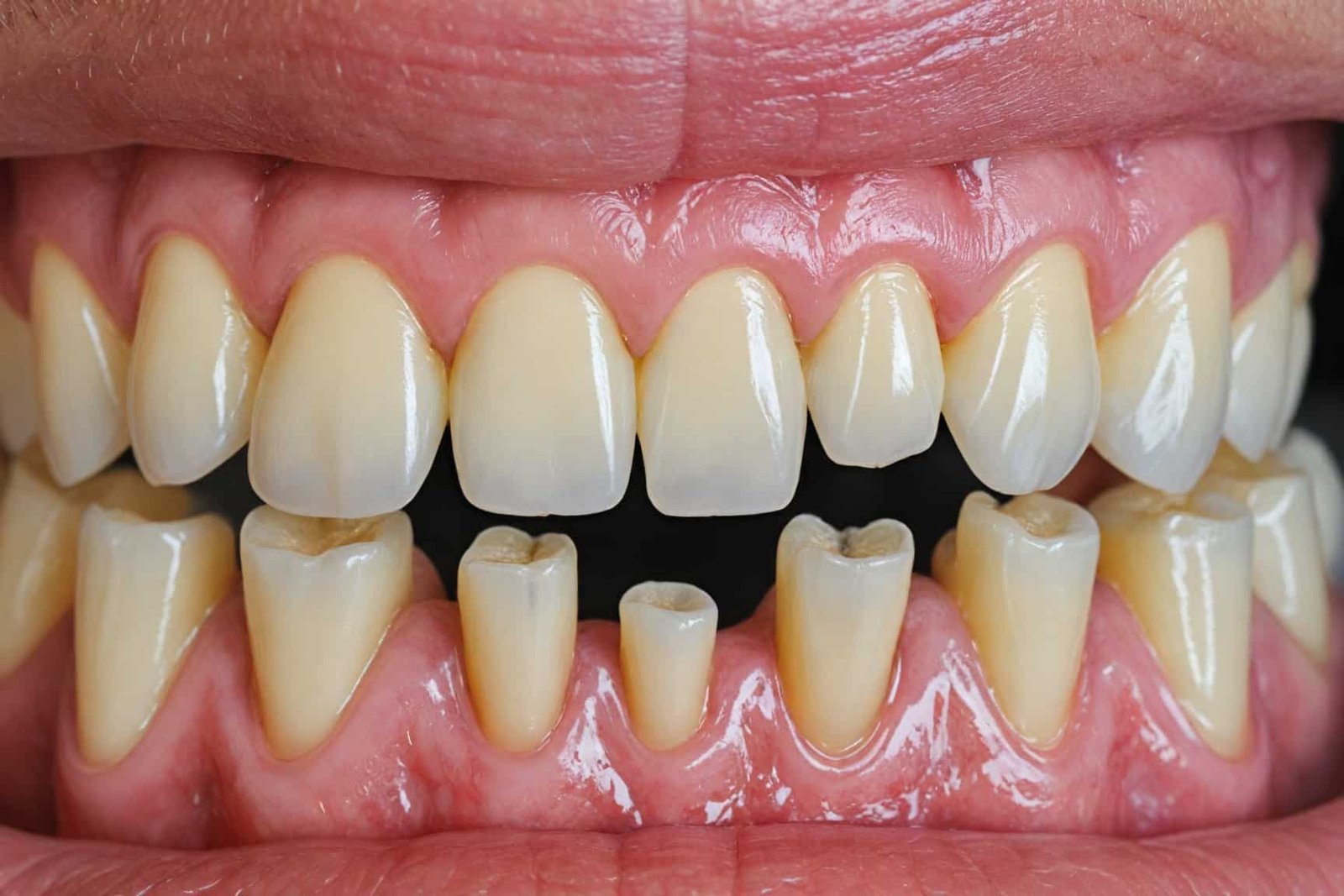
Due to the interdental papilla location, it is susceptible to recession and deterioration from neglect or improper brushing and flossing, as well as dental issues such as gingivitis.
What Is the Interdental Papilla?
The Area of Your Mouth Most Susceptible to Gingivitis
The interdental papilla is the gum tissue found in the space between the teeth. It helps protect the roots of your teeth and keeps food from getting stuck between your teeth, leading to decay.
 |
The Structure of the Interdental Papilla
interdental papilla means a small, nipplelike projection, and papillae are the plural form of the word. In this case, they are structures of the gums that project between the teeth. The structure of the interdental papilla is dense connective tissue covered by oral epithelium. Between your incisors, the interdental papillae are shaped like a pyramid. They are broader for your back teeth.
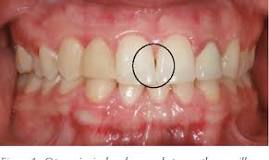
Healthy interdental papillae are a coral pink color. They are firmly attached to your teeth, without gaps. They are shaped like triangles and have a size in proportion to the teeth. If a papilla recedes, you are left with a black triangle.
Interdental Papilla Recession
A periodontist, or a gum specialist, is able to perform surgery that can predictably regenerate gingiva, although the papilla is difficult to obtain. In situations where the interdental papillae are pronounced, the periodontist is able to perform a gingivectomy to remove the extra tissue and resculpt the area. However, these procedures can be difficult and expensive.
Gingivitis
A dentist is able to confirm the extent of your gum disease and thus plan proper treatment accordingly. However, if left untreated or improperly treated, gingivitis can develop and continue to progress into periodontitis, which is even more serious. Periodontitis, unlike gingivitis, is irreversible and often leads to tooth loss.
Sources:
- Gum Disease. American Dental Association. http://www.mouthhealthy.org/en/az-topics/g/gum-disease.
- Singh VP, et. al. Black triangle dilemma and its management in esthetic dentistry. Dental Res J (Isfahan). 2013 May-Jun; 10(3):296-301.