
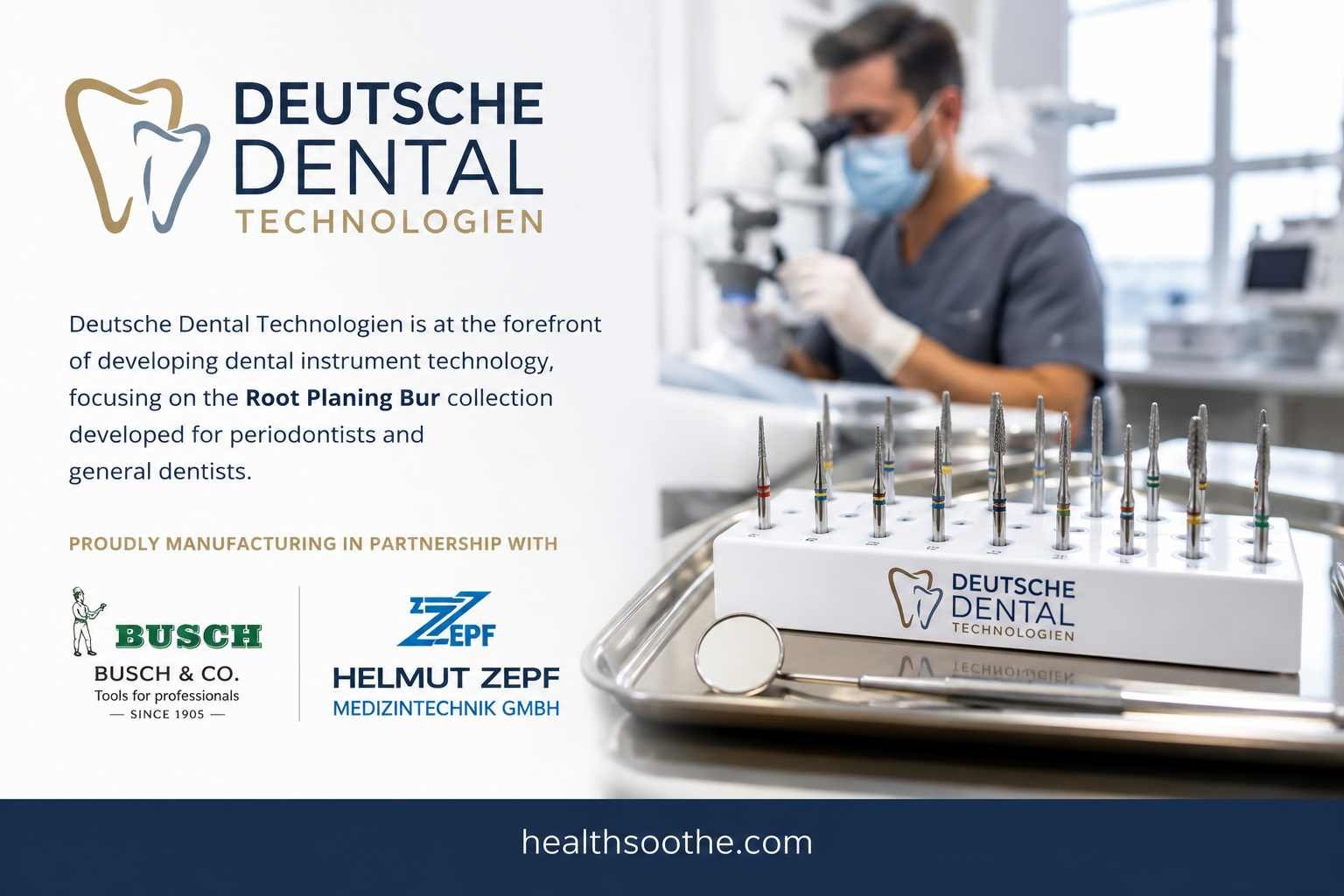
An Introduction to Deutsche Dental Technologien and Its Manufacturing Partners
There are companies that sell dental instruments, and there are companies that understand what clinicians actually need when they are working subgingivally with millimeters between success and tissue trauma. Deutsche Dental Technologien belongs firmly in the second category.
Based in New York and drawing on manufacturing partnerships that stretch back over a century in Germany, Deutsche Dental Technologien has built its reputation on a clear premise: the instruments that go into a patient’s mouth should be made by people who take that responsibility seriously. Two manufacturer partnerships sit at the core of that commitment, Busch & Co. GmbH and Helmut Zepf Medizintechnik GmbH, and the story of how those relationships translate into clinical outcomes is worth understanding before you order another bur.
The Heritage Behind the Brand
Busch & Co. has been manufacturing rotary instruments since 1905. That is not a marketing claim, it is a production timeline that predates most dental schools still operating today. The company, based in Engelskirchen, Germany, spent those decades refining carbide formulations, concentricity tolerances, and cutting geometries to a level that most dental instrument manufacturers do not attempt to match. What you get when you pick up a Busch bur is the accumulated engineering knowledge of a firm that has never had a reason to cut corners.
Helmut Zepf Medizintechnik GmbH, founded in 1921, brings a parallel depth of experience to hand instruments and surgical tools. Zepf instruments are produced in Seitingen-Oberflacht, a small municipality in Baden-Württemberg where precision manufacturing is a tradition rather than a selling point. The company’s catalog covers everything from periodontal probes and Gracey curettes to extraction forceps and microsurgical sets, and each instrument carries the kind of dimensional consistency that comes from genuine quality control rather than a relabeled import.
Deutsche Dental Technologien serves as the US distributor for both manufacturers, which means American clinicians can access these instruments without navigating overseas ordering, customs delays, or the guesswork of dealing with secondary resellers. The team based at 120 Wall Street in New York operates with what they describe as expert instrument assistance, and in practice that means clinicians can reach someone who knows the product catalog in depth, not a call center.
What Periodontics Demands From a Bur
Root planing is one of the more tactilely demanding procedures in general dentistry and periodontics. You are working in a space you often cannot see directly, on a surface that needs to be smoothed without being over-instrumented, and with a rotary instrument that must cut contaminated cementum while leaving healthy root structure intact. The margin for error is not large.
Standard carbide burs were not designed with this clinical scenario in mind. They were optimized for cutting enamel and dentin in prepared cavities, not for the fine, controlled planing motion that subgingival debridement requires. A bur that runs with even minor eccentricity will transmit vibration to the root surface and the surrounding soft tissue, which affects both patient comfort and the quality of the resulting root surface. These are not abstract engineering concerns — they show up in healing outcomes.
This is the problem that Busch set out to solve with its periodontal-specific bur line, and it is why Deutsche Dental Technologien has organized these instruments into a dedicated collection for clinicians who need instruments built for this specific work.
The Root Planing Bur Collection
The Deutsche Dental Technologien Root Planing Bur Collection brings together the Busch instruments developed specifically for periodontal root planing, subgingival debridement, and periodontal scaling. The collection spans carbide and diamond options across multiple head geometries and shank types, giving clinicians the ability to select based on their preferred technique and the clinical anatomy they are working with.
At the center of the collection are the LongLife PERIO-PRO carbide burs, available in both straight and contra-angle configurations and in multiple head sizes. The 406 and 407 series, along with their long-shank variants, are built from the same high-quality German carbide that Busch uses across its clinical rotary line. What distinguishes them from general-purpose carbides is the cutting geometry, which is designed to produce a smooth planing action rather than an aggressive cutting stroke. The difference in tactile feedback between a standard carbide and a dedicated root planing bur is noticeable from the first use.
The diamond options in the collection follow a similar logic. The PERIO PRO diamond burs, including the 8406 and 8407 series in fine and extra-fine grits, are designed for cases where a controlled abrasive action is preferred over a carbide cutting edge. These instruments are particularly useful for smoothing root surfaces after initial debridement, or in situations where the clinician wants to remove a thin layer of cementum with more tactile control than a carbide allows. The fine and extra-fine grit options reflect a practical understanding of how periodontal treatment progresses through different stages.
The flame-tip diamond burs, including the 889 series available in medium, fine, and coarse grits, address the access challenge that subgingival work presents. The geometry of a flame tip allows instrumentation in areas that a round or tapered bur cannot reach cleanly, particularly at the furcation entrance and in pockets with irregular anatomy. Having these available in multiple grit levels from the same manufacturer means the transition between stages of treatment does not require switching instrument brands or recalibrating your technique.
Superior concentricity runs through the entire collection as a baseline specification rather than a premium feature. Every Busch bur is manufactured to minimize runout, which in clinical terms means the bur tracks true at the speeds used for periodontal procedures. That consistency protects root surfaces from unintended damage and reduces the micro-vibration that contributes to patient discomfort during longer appointments.
Designed for Periodontists and General Dentists Alike
Root planing is not an exclusively specialist procedure. General dentists perform non-surgical periodontal therapy regularly, and the quality of that treatment has a direct impact on whether patients develop more advanced disease that requires referral. Deutsche Dental Technologien has positioned the Root Planing Bur Collection for both audiences, and the collection works equally well for a periodontist managing post-surgical root surface preparation and a general dentist performing closed debridement in a patient with moderate chronic periodontitis.
For the periodontist, the depth of the collection offers options for every stage of treatment. The carbide PERIO-PRO burs handle the initial removal of calculus and contaminated cementum in open-flap procedures, the diamond burs follow for surface refinement, and the range of head sizes accommodates the varying anatomy encountered across anterior, premolar, and molar sites. The long-shank variants extend reach in situations where standard shank length is limiting.
For the general dentist, the collection provides a coherent selection of purpose-built instruments rather than the compromise of adapting general-purpose burs to a task they were not designed for. There is clinical value in using an instrument that was engineered for the specific demands of root surface work, and patient outcomes reflect it.
The Practical Case for German Manufacturing
German dental manufacturing carries a reputation that is sometimes treated as marketing shorthand, but in the case of Busch and Zepf it reflects something specific. Both companies produce instruments in facilities where tolerances are controlled at the micron level and quality inspection is built into the production process rather than conducted as a downstream check. The result is batch-to-batch consistency that clinicians can depend on when ordering replacement instruments.
That consistency matters more in periodontics than in some other areas of dentistry. When you are working subgingivally with instruments that the patient cannot see and that you are guiding by tactile feedback alone, you need to know that the instrument in your hand performs the same way every time. An inconsistent bur introduces variables into a procedure that already has enough of them.
Deutsche Dental Technologien’s role is to make that manufacturing quality accessible to US clinicians without the complexity of direct overseas sourcing. The company maintains US inventory, provides instrument support from people who know the products, and backs purchases with a return policy that reflects confidence in what they are selling.
A Final Word on Instrument Selection
Periodontists and general dentists evaluating their instrument supply have no shortage of options. What makes the Deutsche Dental Technologien Root Planing Bur Collection worth a closer look is the specificity of purpose behind each instrument in it. These are not general carbide burs that happen to be usable for root planing. They are instruments that Busch developed for periodontal applications, backed by more than a century of manufacturing experience and distributed by a company that takes product knowledge seriously.
If root planing is a regular part of your practice, the instruments you use for it deserve the same level of consideration you give to the technique itself. The collection at Deutsche Dental Technologien is a reasonable place to start that evaluation.
Deutsche Dental Technologien | 120 Wall Street, 20th Floor, New York, NY 10005 | (917) 480-2682 | [email protected]