
Medically Reviewed
This article has been reviewed for clinical accuracy.
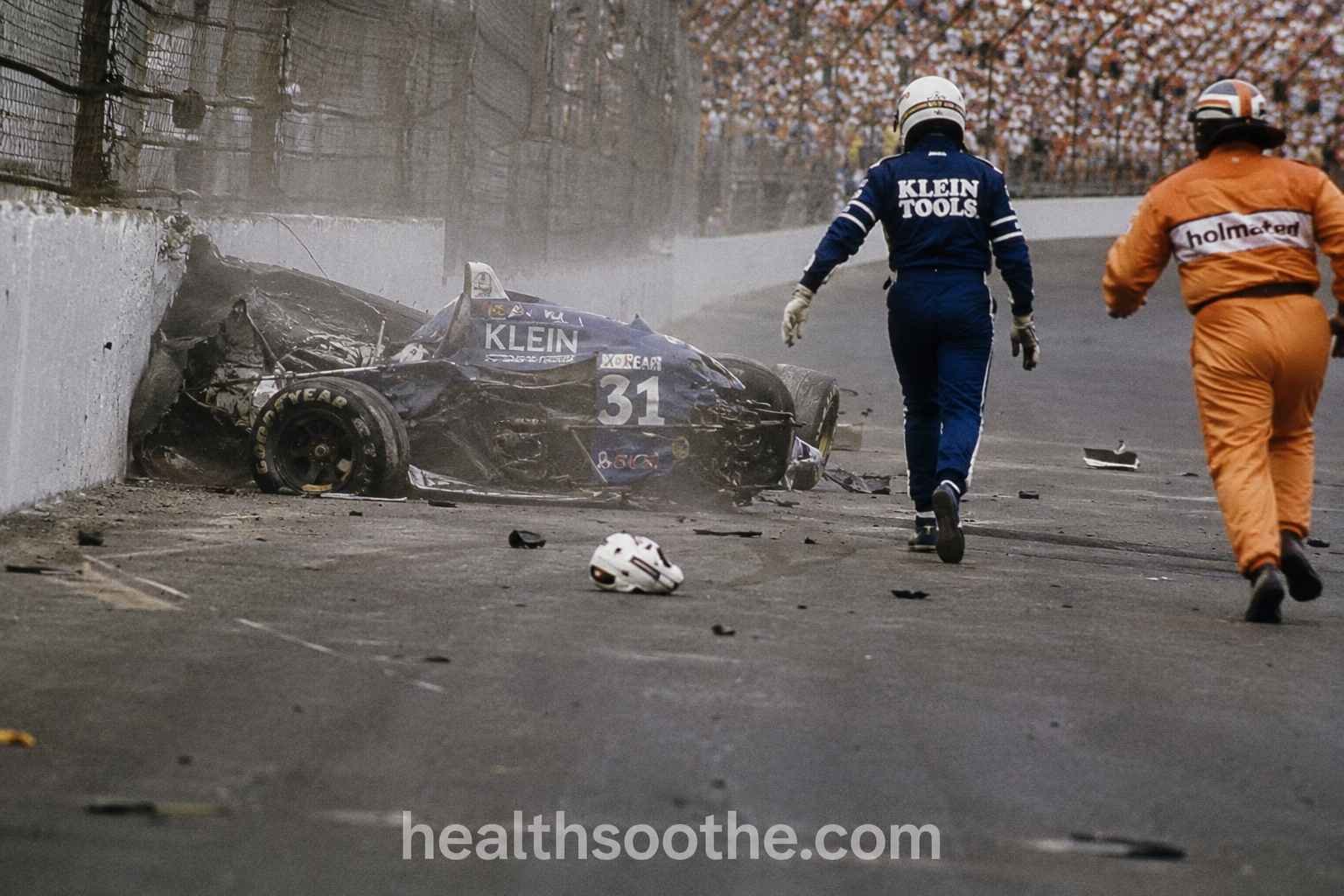
On May 15, 1982, Gordon Smiley entered the Indianapolis Motor Speedway for a qualifying lap attempt for the Indianapolis 500. He never completed it.
Smiley’s car lost traction exiting turn three, and his attempt to correct the slide against the explicit advice of veteran drivers sent his car directly into the concrete retaining wall at 200 miles per hour. He died instantly from massive head trauma.
He was 33 years old.
His death was the first at Indianapolis since 1973, and it remains the last fatality during an Indy qualifying session to this day. More importantly, it became a turning point in how motorsport understood, prevented, and responded to traumatic head injuries lessons that continue to shape racing safety and trauma medicine four decades later.
Related accident:
Who Was Gordon Smiley?
Gordon Smiley was an open wheel racing driver from Nebraska who had built a reputation as a determined and aggressive competitor. By 1982 he had competed across various racing circuits and had earned a place on the starting grid at one of motorsport’s most prestigious events.
Those who knew him described a driver with tremendous passion and self-belief qualities that served him well in competition but contributed to the decisions he made on the day of his death. Several veteran Indianapolis drivers had warned Smiley in the days before the crash that his driving style developed on road courses was incompatible with the particular demands of oval track racing at high speed. He was told specifically not to attempt to correct a slide if his car lost traction, as the physics of oval racing make correction attempts catastrophic at qualifying speeds.
He did not follow that advice.
What Happened on May 15, 1982
The afternoon session was already charged with competitive intensity. Kevin Cogan and Rick Mears had both set record qualifying averages earlier that day, and Smiley was determined to match or exceed 200 mph in his attempt.
During his warm-up lap intended to bring tyre temperatures to optimal operating range, not to set speed. Smiley was already pushing the car at race pace. On the second warm-up lap, the car began to slide exiting turn three. Following his instinct rather than the advice he had been given, Smiley steered into the correction. The front wheels abruptly regained traction, which redirected the car violently across the track and directly into the concrete barrier wall.
The impact occurred at approximately 200 mph. The crash was not survivable.
The Medical Reality of a 200mph Head-On Impact
Understanding what happens to the human body in a direct 200mph wall impact is important not for shock value, but because it explains why head and neck protection became the defining focus of racing safety reform in the years that followed.
Traumatic brain injury at extreme velocity
At 200mph, the deceleration force experienced by a driver in a direct wall impact is measured in hundreds of G-forces far beyond the threshold of human survival. The brain, which floats in cerebrospinal fluid inside the skull, cannot withstand that level of sudden deceleration. At survivable crash speeds, this mechanism causes concussion, contusion, or diffuse axonal injury. At the speeds involved in Smiley’s crash, the structural integrity of the skull itself is overwhelmed.
The fatal injury in Smiley’s case was catastrophic head trauma the most severe classification of traumatic brain injury, characterised by injuries so extensive that survival is not possible regardless of medical intervention.
Why helmet design in 1982 was insufficient
The helmets used in open-wheel racing in 1982 were designed primarily to protect against fire and moderate impacts. They were not engineered to manage the rotational acceleration forces now understood to be the primary cause of severe brain injury in high-speed crashes. The helmet in a 200mph direct impact simply cannot absorb forces of that magnitude with 1982 technology.
This understanding that helmets needed to be fundamentally redesigned around rotational force management rather than just impact absorption became a central focus of motorsport safety research in the decades following Smiley’s death.
Facial and dental trauma in high-speed wall impacts
In crashes of this severity, facial and dental trauma is always present even when it is secondary to fatal head injuries. The forces involved in a direct wall impact cause:
- Complete mandibular and maxillary fracture: The upper and lower jaws cannot withstand the compressive and shear forces of a direct high-speed impact
- Full dental avulsion: All teeth are typically displaced from their sockets simultaneously
- Orbital and zygomatic fracture: The bones of the eye socket and cheek are among the first facial structures to fail under impact loading
- Soft tissue destruction across the entire facial region
In survivable crashes at lower speeds, these are the injuries that trauma dental teams and maxillofacial surgeons treat. Understanding how they occur at extreme speeds has informed the design of modern racing helmets, HANS devices, and impact-absorbing cockpit structures, all of which are now standard across major racing categories.
What Changed After Gordon Smiley’s Death
Smiley’s crash along with the deaths of several other drivers across major racing categories in the late 1970s and early 1980s accelerated safety research that ultimately transformed the sport.
Cockpit and chassis redesign
The March chassis Smiley drove in 1982 offered minimal head protection beyond the helmet. Modern Formula One and IndyCar cockpits now include the Halo device a titanium structure surrounding the driver’s head capable of withstanding 125 kilonewtons of force which has been credited with saving multiple drivers’ lives since its mandatory introduction in 2018. The survival cell concept, in which the cockpit is engineered as an independent structural unit that maintains its shape during a crash, became standard across all major open-wheel categories following systematic safety reviews triggered in part by crashes like Smiley’s.
The HANS device
The Head and Neck Support device, developed through research that followed multiple high-speed fatalities in the 1980s and 1990s, became mandatory in NASCAR in 2001 following Dale Earnhardt’s death and spread across all major categories thereafter. The HANS device prevents the violent forward head movement during frontal impacts that causes basilar skull fractures and the specific injury mechanism responsible for Earnhardt’s death and a contributing factor in multiple earlier fatalities.
Track barrier evolution
The concrete retaining wall that Smiley’s car struck in 1982 reflected the circuit design philosophy of the era. The hard barriers that stopped cars but transferred maximum energy into the vehicle and driver. The development of SAFER barriers Steel and Foam Energy Reduction structures that absorb and dissipate impact energy rather than reflecting it. Began in the 1990s and became mandatory at Indianapolis in 2002. Studies have demonstrated that SAFER barriers reduce peak deceleration forces in wall impacts by up to 50% compared to concrete alone, directly reducing the severity of head, facial, and dental trauma in crashes that are otherwise similar in nature to Smiley’s.
Medical response protocols
The response to Smiley’s crash in 1982 reflected the emergency medicine capabilities of the era. Modern racing circuits are required to have trauma teams, medical cars, and air evacuation capabilities on standby at all times. Response protocols for head injury specifically immobilising the cervical spine before extraction, managing intracranial pressure at the scene, and directing drivers to specialist neurosurgical facilities have been standardised across all major series in the decades since.
The Legacy of Gordon Smiley
Gordon Smiley remains the last driver to die during an Indianapolis 500 qualifying session. That record reflects not a lucky streak but a systematic, decades-long effort to understand the physics of high-speed crashes and the medical realities of head and facial trauma and to engineer solutions that give drivers a survivable outcome from accidents that would have been fatal in 1982.
His death, and the deaths of others in that era, gave motorsport safety researchers the understanding they needed to develop the helmet technologies, cockpit structures, barrier systems, and medical protocols that have saved demonstrably many lives since.
That is a legacy worth understanding and one that continues to inform how trauma medicine and emergency dental care approach high-speed impact injuries to this day.